

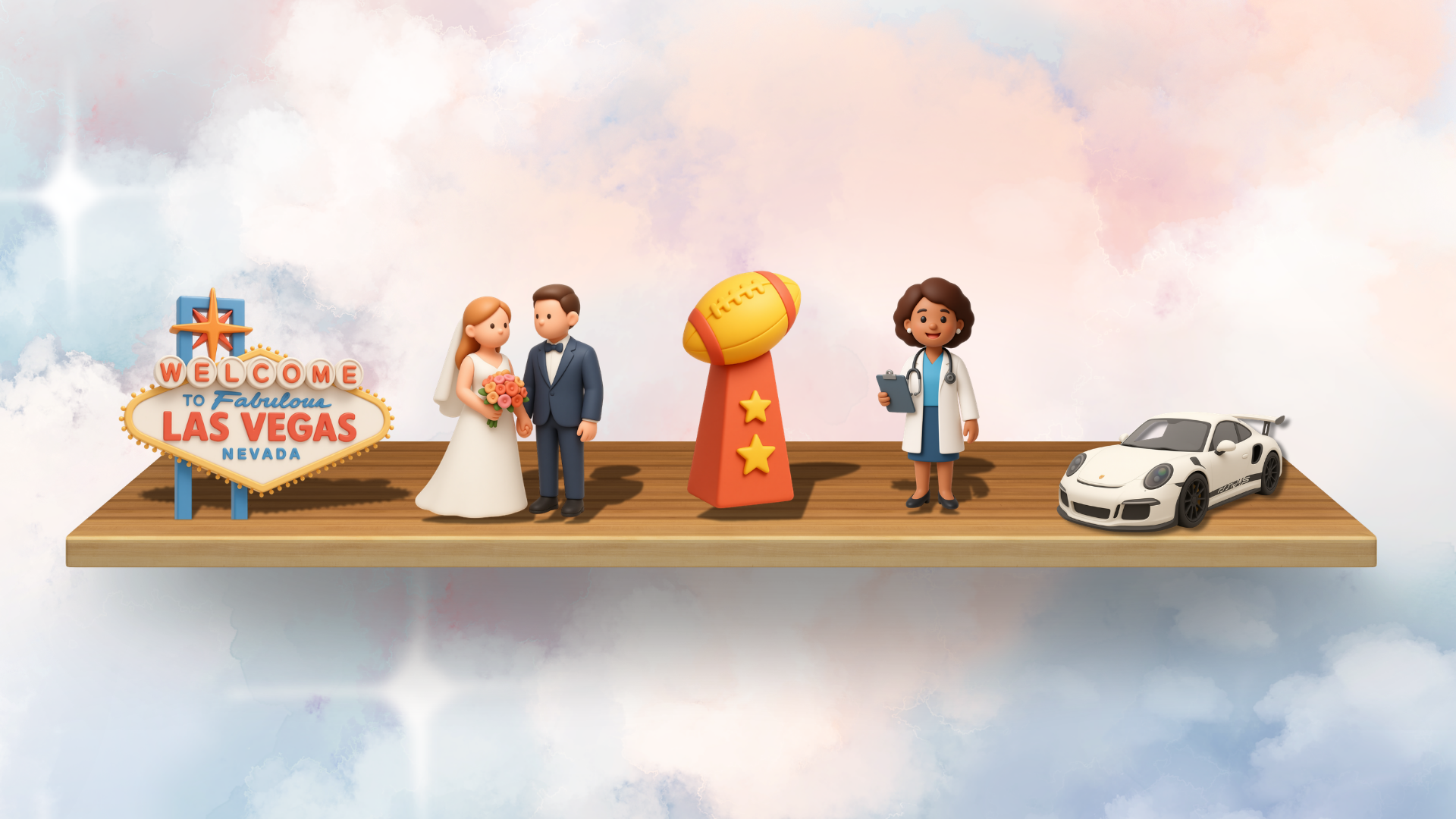
I imagine death so much it feels more like a memory.
Any Hamilton fans out there?
That line has always stuck with me. Lin-Manuel Miranda, the show’s creator and writer, captures something strange about the way we relate to the future. Alexander Hamilton has not yet been killed, but in his mind, the idea takes on a life of its own. Almost like a memory.
We do this all the time — we don’t only keep memories of the past. We also create “memories” of the future.
Keepology calls these: “tomorrow-memories.”
tomorrow-memory (n.) \ tə-ˈmär-(ˌ)ō-ˌme-m(ə-)rē \ — an imagined future experience that becomes familiar enough to feel like a memory.
My wife and I like to invent fake German words when English falls short. Family members you feel obligated to invite to your wedding are oblichenfamen. When you abruptly quit your job, you werkundpoof!
The Germans don’t always get everything right. But man, they know how to pack a word with meaning. You probably know schadenfreude and doppelgänger. So I looked to ze Germans to inspire a compound word of magnitude. A word with gravitas. I found the perfect German phrase: Erinnerung an die Zukunft, or “memory of the future.” A bit wordy but that’s no problem, we can compress it.
Ladies and gentlemen, Keepology presents: Zukunftserinnerung.
Hmm. Doesn’t exactly roll off the tongue, does it? Perhaps, Zukunftserinnerung isn’t destined to enter the zeitgeist.
“Tomorrow-memory” it is.
Best of Intentions
“I’ll be a doctor someday.”
“I will own a Porsche.”
“I hope to be a mother.”
Some goals exist as vague impressions while others you see clear as day. Tomorrow-memories are abstract possessions, but they can become part of us all the same.
Some people live in the past. But can we live in the future?
“What if I fail my exam?”
“Will a deer destroy my garden tonight?”
“What if my girlfriend dumps me?”
Some tomorrow-memories are worries or fears. We imagine failure, embarrassment, loss, or an animal treating our garden like a salad bar.
Other tomorrow-memories come with a calendar invite. They have a time, date, and place. You know who will be there, what you’ll do, maybe even what you’ll wear.
High school graduation. Your wedding day. Backstreet Boys performing at The Sphere.
Let’s say you get tickets to the Super Bowl.
“I’m going to the Super Bowl.”
You plan your trip. You wonder which celebrities you might see. You look up your seats on the stadium map to help imagine the view. You tell your friends and family. You post about it online.
Gradually, “I’m going to the Super Bowl” morphs into: I’m someone who goes to the Super Bowl.
Your identity shifts.
“I can always say I went to the Super Bowl,” you think to yourself. “I can tell my grandkids about this someday.”
Have you ever said that? The grandkids thing?
This is actually insane. Let me explain.
We’re saying that one day, in an imagined distant future—which apparently includes grandchildren—we may look back on a time in our imagined future’s past, which is our present-day future.
(Read that one more time if you need to. I did, and I wrote it.)
And none of it has actually happened yet!
Folks, that is a tomorrow-memory.
And apparently I am not the first person to notice that the brain gets a little loosey-goosey with time.
Psychologists call a similar concept episodic future thinking: the ability to imagine or simulate experiences that might occur in your personal future. Researchers found that imagining future experiences and remembering past ones rely on many of the same cognitive and neural processes. One theory, the “constructive episodic simulation hypothesis,” suggests that we imagine the future by recombining details from memory into a new possible scene.
In other words, your brain takes pieces of yesterday and uses them to mock up tomorrow.
But it gets weirder.
Tomorrow-memories begin to influence the present.
Returning to our Super Bowl analogy, maybe I think the kind of person who attends the Super Bowl acts and dresses a certain way. So I start to walk with a pep in my step. I up my style game. I feel more confident and ask my longtime crush out on a date—things I might not have done without my new imagined future.
A vision of what is to come can change us long before it ever takes place.
A tomorrow-memory is the vacation you haven’t taken yet, but whose Airbnb listing you keep revisiting. It’s the child you haven’t had yet, but already imagine holding. It’s the version of yourself you haven’t become yet, but already consider when making decisions.
These are not memories in the typical sense, but they behave a lot like them.
Not every tomorrow-memory comes to fruition. Some fade. Some morph. Some were probably a bit unrealistic from the get-go. Looking at you, Porsche.
But every now and then, one of these imagined futures becomes familiar enough that we begin to move toward it.
We give it time and attention.
We let it become part of us before it’s real.
And if the moment does finally show up, hopefully we don’t throw away our shot.
-Eddie
References:
Schacter, D. L., & Addis, D. R. (2007). On the constructive episodic simulation of past and future events. Behavioral and Brain Sciences, 30(3), 331–332.
Schacter, D. L., Benoit, R. G., & Szpunar, K. K. (2017). Episodic future thinking: Mechanisms and functions. Current Opinion in Behavioral Sciences, 17, 41–50.
Guddershitten !!
Margie & Suesan
"Live in the now!" - Garth Algar
I love the term you've coined. Are there people who *don't* have tomorrow-memories?